Rachel is 49, lives in Irvine, California, and has spent most of her adult life doing what responsible people are told to do.
She built a steady career as a nonprofit program director, raised two children and helped manage a household while her husband, Mark, grew a successful consulting business. She earns $85,000 a year. Mark earns about $550,000 through salary, bonuses and business distributions.
Their children, ages 25 and 23, have jobs, apartments and lives of their own. There are no more college bills, soccer schedules or dependent children keeping Rachel tied to the family routine.
For the first time in decades, she can make a decision based mostly on what she wants.
And what she wants is a fresh start.
Rachel plans to end her 26-year marriage, rebuild her finances and retire at 55. She imagines traveling more, having time for friends and volunteering without squeezing everything around work. She does not want an extravagant retirement, but she does want one that feels comfortable.
Her target is $125,000 a year in today’s dollars.
The divorce settlement will leave her wealthy by almost any ordinary measure. But Rachel’s real question is not whether she will receive a large settlement.
It is whether that settlement will actually support four decades of retirement.
She has three choices.
She can keep the family home and receive temporary spousal support. She can downsize, invest more money and still receive support. Or she can take a larger portfolio now and give up alimony completely.
Each option sounds attractive for a different reason. Each comes with a catch.
Rachel’s retirement target
Rachel wants to spend $125,000 a year in today’s dollars:
- $100,000 for essential expenses.
- $25,000 for travel, entertainment and other discretionary spending.
That target rises with inflation. By the time Rachel turns 55, her projected annual spending is nearly $145,000. It climbs to about $186,000 at 65, $210,000 at 70 and almost $269,000 at 80.
Her estimated Social Security benefit is $2,500 a month at full retirement age. That will help, but it will not come close to covering her planned lifestyle.
Rachel’s settlement therefore has to do more than look generous. It has to produce enough money before Social Security begins and continue supporting her long after spousal support ends.
The three settlement choices
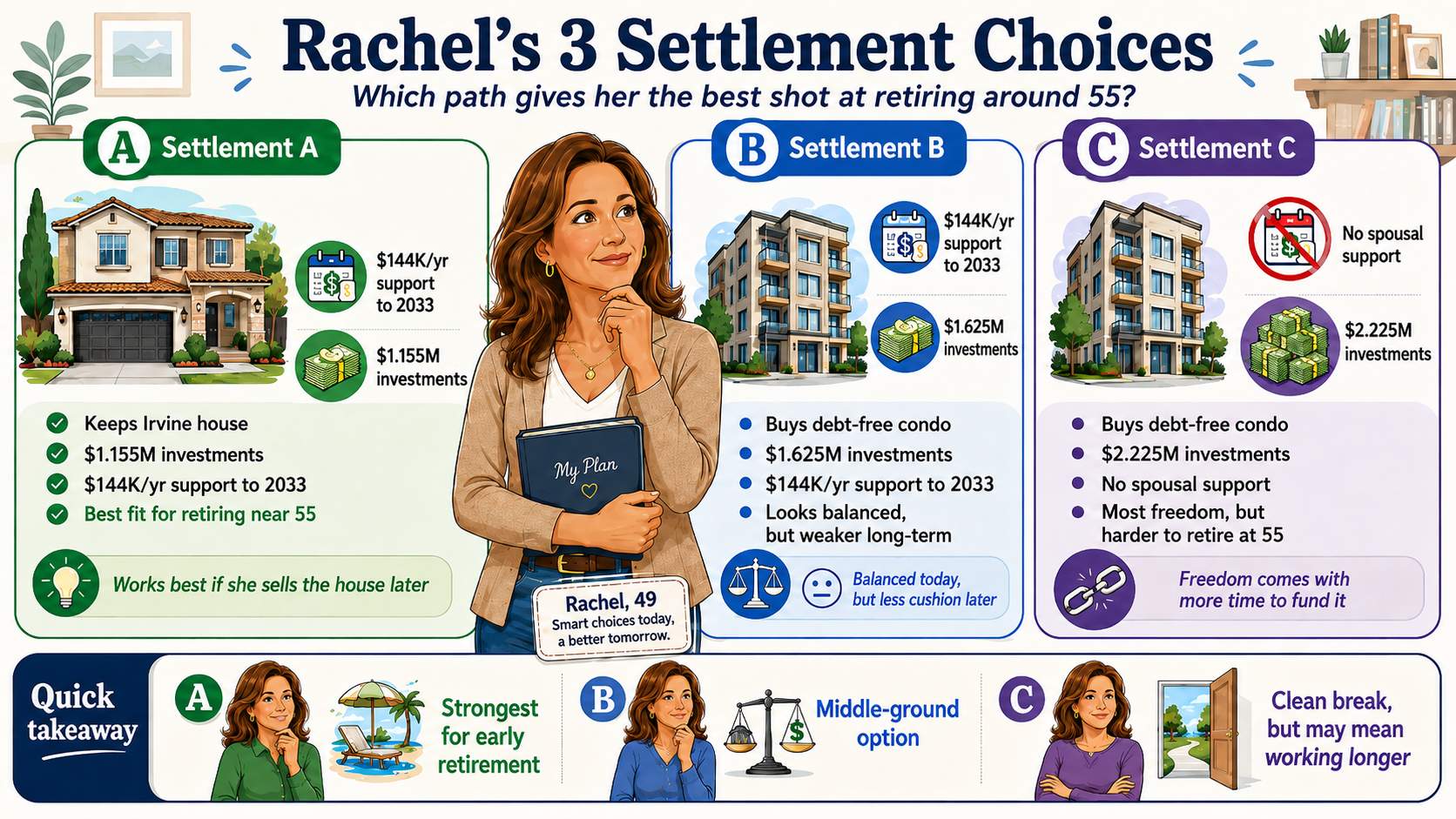
| Settlement A | Settlement B | Settlement C | |
|---|---|---|---|
| Housing | Keeps Irvine home | Buys debt-free condo | Buys debt-free condo |
| Starting home equity | $1.17 million | $700,000 | $700,000 |
| Starting investment accounts | $1.155 million | $1.625 million | $2.225 million |
| Annual spousal support | $144,000 | $144,000 | $0 |
| Support period | 2026 through 2033 | 2026 through 2033 | None |
| Main benefit | Valuable home plus support | More liquidity plus support | Immediate financial separation |
| Main drawback | Low investable balance | Smaller housing asset | Gives up substantial future income |
Settlements A and B start with roughly the same combined value in investments and home equity: $2.325 million.
The difference is where the money sits.
Settlement A puts more of Rachel’s wealth into the family home. Settlement B shifts $470,000 from home equity into investments. Settlement C gives Rachel another $600,000 in investments, but she gives up spousal support entirely.
Which choice looks best at first?
Before looking at the long-term numbers, Settlement B probably sounds like the most sensible option.
Rachel downsizes, loses the mortgage, gains more money to invest and still receives $12,000 a month in support. It feels balanced. She is not clinging to the large house, but she is not cutting herself off from a valuable income stream either.
Settlement C may sound best emotionally.
Rachel gets a debt-free condo, the largest investment portfolio and no longer has to depend on Mark. No monthly payments. No worries about whether his business slows down. No future arguments about support. She can close that chapter and move on.
Settlement A is the hardest one to love at first glance.
Rachel keeps the expensive family home, starts with the smallest investment portfolio and remains responsible for the mortgage and upkeep. It looks like the classic house-rich, cash-poor mistake.
Most people would probably rank the choices like this:
- Settlement B feels practical.
- Settlement C feels freeing.
- Settlement A feels risky.
The long-term results turn that order upside down.
Settlement A: Keep the house now, sell it later
Under Settlement A, Rachel keeps the $1.45 million Irvine home and its $280,000 mortgage.
She starts with:
- $155,000 in taxable investments.
- $1 million in a traditional IRA.
- $1.17 million in home equity.
- $144,000 a year in spousal support through 2033.
This option gives Rachel the smallest investment portfolio of the three. Most of her wealth is sitting in the house.
For the first several years, that is not a major problem. Rachel is still working, and the combination of her $85,000 salary and $144,000 in support gives her $229,000 in annual income before taxes.
Once work and support end, however, her investments begin falling quickly.
Her portfolio is projected to reach about $2.05 million at age 56. By 65, it falls to roughly $661,000. At 67, it is down to about $293,000. At 68, only around $97,000 remains.
That is the kind of number that makes retirees nervous.
But Rachel still owns the house.
At age 68, the plan sells the Irvine property for approximately $3.18 million. By then, the mortgage has been paid off. The sale turns years of home appreciation into spendable retirement money.
That single move changes the outlook.
After selling, Rachel can delay Social Security until 70. Her portfolio remains above $3 million for much of her 70s and finishes at approximately $2.5 million at age 95.
Most of the ending balance — about $2.22 million — is projected to sit in a Roth IRA.
The plan also gives Rachel a useful tax-planning window. After support ends, she can begin converting money from her traditional IRA into a Roth IRA, including projected conversions of about $62,150 a year from ages 57 through 64.
The catch
Settlement A works only if Rachel treats the house as a future retirement asset.
Keeping the home forever is not part of the successful strategy. The plan depends on selling it around age 68 and investing the proceeds.
That means Rachel can stay in the house for years, enjoy the familiarity and avoid making every major life change at once.
But eventually, the house has to do its job.
How Settlement A holds up
Under average investment conditions, Settlement A remains funded through age 95 and leaves about $2.5 million.
Under a strong market environment, the ending balance rises to roughly $15 million.
The weaker scenarios are less forgiving:
- Under pessimistic conditions, the portfolio runs out around age 84.
- Under stagflation, it runs out around age 67.
- Under a severe recession, it runs out around age 70.
Across 1,000 randomized market trials, the plan succeeds through age 95 only 9.6% of the time. Among the unsuccessful trials, the average first depletion age is 68.
That is not exactly a sleep-well-at-night result.
Still, it is the best of Rachel’s three choices.
The retirement analysis suggests age 56 as the more supportable retirement date — only one year later than her goal.
Settlement B: The reasonable compromise that falls short
Settlement B looks like the practical middle ground.
Rachel sells the Irvine home, buys a $700,000 condo with cash and increases her investable assets to $1.625 million.
She also keeps the same $144,000 annual support through 2033.
Compared with Settlement A, Rachel has:
- $470,000 less home equity.
- $470,000 more in investments.
- No mortgage.
- Lower ongoing housing costs.
- More flexibility if she needs cash.
Her investment portfolio grows to about $2.63 million at age 55 and reaches approximately $2.92 million near age 60.
That looks stronger than Settlement A’s investment balance at the same stage.
The problem arrives later.
The condo appreciates, but it never becomes as valuable as the Irvine house. When Rachel’s portfolio begins running low, she has less home equity available to refill it.
The plan sells the condo around age 79 for approximately $2.36 million. That keeps Rachel’s retirement going for another decade, but the portfolio eventually runs out around age 90.
Only the optimistic market scenario succeeds through age 95, leaving approximately $5.59 million. The other economic scenarios deplete early.
The randomized projections are also weak:
- 7.6% probability of lasting through age 95.
- 92.4% probability of depletion.
- Average depletion age of 65 among unsuccessful trials.
- 53.3% probability of running short before age 80.
The analysis points to age 62 as the more realistic retirement age.
Settlement B is not a disaster. It just does not do anything especially well.
Rachel gives up the larger home, but she still depends on Mark’s support. She gains liquidity, but not enough to make the age-55 plan hold together.
It is the option that feels smart in conversation and looks less impressive on paper.
Settlement C: A clean break with an expensive price
Settlement C gives Rachel the most immediate independence.
She receives:
- A $700,000 debt-free condo.
- $1.05 million in taxable investments.
- $1.175 million in a traditional IRA.
- No spousal support.
Her total investment portfolio starts at $2.225 million, which is $600,000 more than under Settlement B.
In exchange, Rachel gives up $144,000 a year in support from 2026 through 2033.
That is $1.152 million in total scheduled payments.
The $600,000 increase in investments replaces only about 52% of that amount before considering investment growth, payment risk or the value of receiving money sooner.
A lump sum has real appeal. Rachel owns it immediately. Mark cannot later ask a court to reduce it. She does not have to think about his business income, retirement plans or willingness to pay.
There is also something emotionally satisfying about being done.
No monthly deposit from an ex-husband. No financial connection lingering for years. No wondering whether the next chapter still depends on the last one.
But the amount still has to be large enough.
In Rachel’s case, it is not.
Her $85,000 salary does not fully cover her spending and taxes, so her investments have to begin filling the gap right away.
Her portfolio grows to about $2.85 million at 55 and stays near $3 million through much of her early 60s. Over time, withdrawals begin outpacing growth.
The condo is sold around age 80 for approximately $2.46 million. The proceeds extend the plan, but the portfolio eventually runs out around age 91.
The randomized projections show:
- 8.6% probability of lasting through age 95.
- 91.4% probability of depletion.
- Average depletion age of 64 among unsuccessful trials.
- 54.9% probability of running short before age 80.
The retirement analysis points to age 71 as the more supportable retirement age.
That does not necessarily mean Rachel must work until 71. It means the clean-break settlement does not provide enough financial support for her current spending target and planned retirement at 55.
There is also an important limitation in the numbers: Rachel’s employment income ends in 2032 in all three settlement cases, even when a later retirement age is recommended.
A delayed retirement would improve the outcome only if Rachel actually continued working and earning beyond 2032. The later retirement ages are better viewed as warning lights than exact answers.
Which settlement is best?
For Rachel’s stated goal, Settlement A is the strongest choice.
It is the only option that remains funded through age 95 under average conditions. It produces the highest randomized success rate of the three, supports delaying Social Security until 70 and creates room for meaningful Roth conversions.
It also puts Rachel closest to retiring at 55.
But Settlement A is not really a “keep the house” plan.
It is a “keep the house for now, then sell it” plan.
The projected $3.18 million home sale at age 68 is what rescues Rachel’s portfolio. Without it, her liquid assets would be nearly exhausted before Social Security begins.
That makes Settlement A the best fit only if Rachel is genuinely willing to downsize later.
What freedom means to Rachel
Rachel’s choice depends partly on how she defines freedom.
If freedom means eliminating every financial tie to Mark, Settlement C is the cleanest option. She receives more money upfront and never has to count on a monthly payment.
But she would probably need to make another compromise somewhere else:
- Negotiate a larger buyout.
- Work longer.
- Spend less.
- Claim Social Security earlier.
- Sell the condo sooner.
- Accept a higher chance of running out of money.
If freedom means leaving the marriage while preserving a realistic shot at retiring near 55, Settlement A is the better fit.
She remains connected to Mark through support for several years, but that support helps her make the transition. Later, the house becomes the asset that funds the second half of retirement.
Settlement B offers the least satisfying mix. Rachel gives up the more valuable property but still relies on support. It provides neither the strongest retirement outcome nor the cleanest break.
Can Rachel really retire at 55?
Possibly, but she does not have much room for surprises.
Settlement A works under average return assumptions. The randomized projections, however, show that Rachel remains highly exposed to market losses, inflation and poorly timed withdrawals.
A 9.6% probability of lasting through age 95 is not a comfortable retirement plan.
Rachel can improve her odds by making a few practical adjustments.
Sell the house before she has to
Rachel should decide in advance when she would be willing to move.
Waiting until the portfolio is nearly empty could force her to sell during a weak housing market or at a time when moving feels especially difficult.
A planned sale is a strategy. A forced sale is a crisis.
Keep the fun money flexible
Rachel has $25,000 a year set aside for travel and other nonessential spending.
That does not mean she has to give up vacations. It means a big trip may need to wait after a bad market year.
A little flexibility could make a meaningful difference over a long retirement.
Use the support years well
The $144,000 in annual support should make Rachel more independent over time, not simply support a more expensive lifestyle.
While she is still working, those payments give her a rare chance to preserve investments, build cash reserves and prepare for the day the checks stop.
Make the most of lower-tax years
After support ends and before Social Security begins, Rachel may have several years with lower taxable income.
Those years could be a good time to move money from her traditional IRA into a Roth IRA, potentially reducing future taxes.
Take a harder look at health care
The retirement assumptions include only $2,000 a year in medical out-of-pocket costs before Medicare.
They do not include a separate health insurance premium between ages 55 and 64. That could be a meaningful expense.
Rachel also has no long-term care insurance and no dedicated reserve for future care. A retirement that may last until 95 should leave room for more than routine doctor visits.
Rachel may be able to leave her marriage and retire early.
But she cannot treat each part of the settlement as interchangeable.
The support payments, the house, the investment accounts and Social Security all arrive at different times and serve different purposes.
For Rachel, the best settlement is not the one that feels most independent on day one.
It is the one that gives her the best chance of staying independent for the rest of her life.
Educational Disclaimer
The financial projections, strategies, and verdicts presented in this case study are for educational purposes only. They rely on assumptions about market returns, inflation, and tax rates that are inherently unpredictable. This content does not constitute personalized financial, legal, or tax advice. Always consult with a qualified financial professional before making retirement decisions.
Related Case Studies

Can Four Rentals Fund an Early Retirement at 52?
Daniel and Maya have built serious real estate wealth. Turning it into a reliable paycheck is the harder part.

Laid Off at 58 and Replaced by AI: Can Marcus Retire?
Marcus has $1.82 million invested, a pension and valuable home equity. But an unexpected early retirement could leave him short later.

At 40, Alex Wants a Passport, Not a Mortgage
He has $1.5 million invested, no house and no debt. Can renting help him retire early and travel the world?