Rebecca has done almost everything right.
At 56, she has $1.25 million in her 401(k), $280,000 in a brokerage account and $70,000 in cash. Her children are financially independent, her mortgage is manageable, and she expects to spend about $92,000 a year in retirement.
She appears ready to leave work. But most of her money is sitting in an account she had expected to leave untouched until age 59½.
Rebecca could spend down her cash and brokerage account for the next few years. Or she could use the Rule of 55 to begin withdrawing from her 401(k) without the usual 10% early-distribution tax.
That sounds like a retirement shortcut. In reality, it is a trade-off.
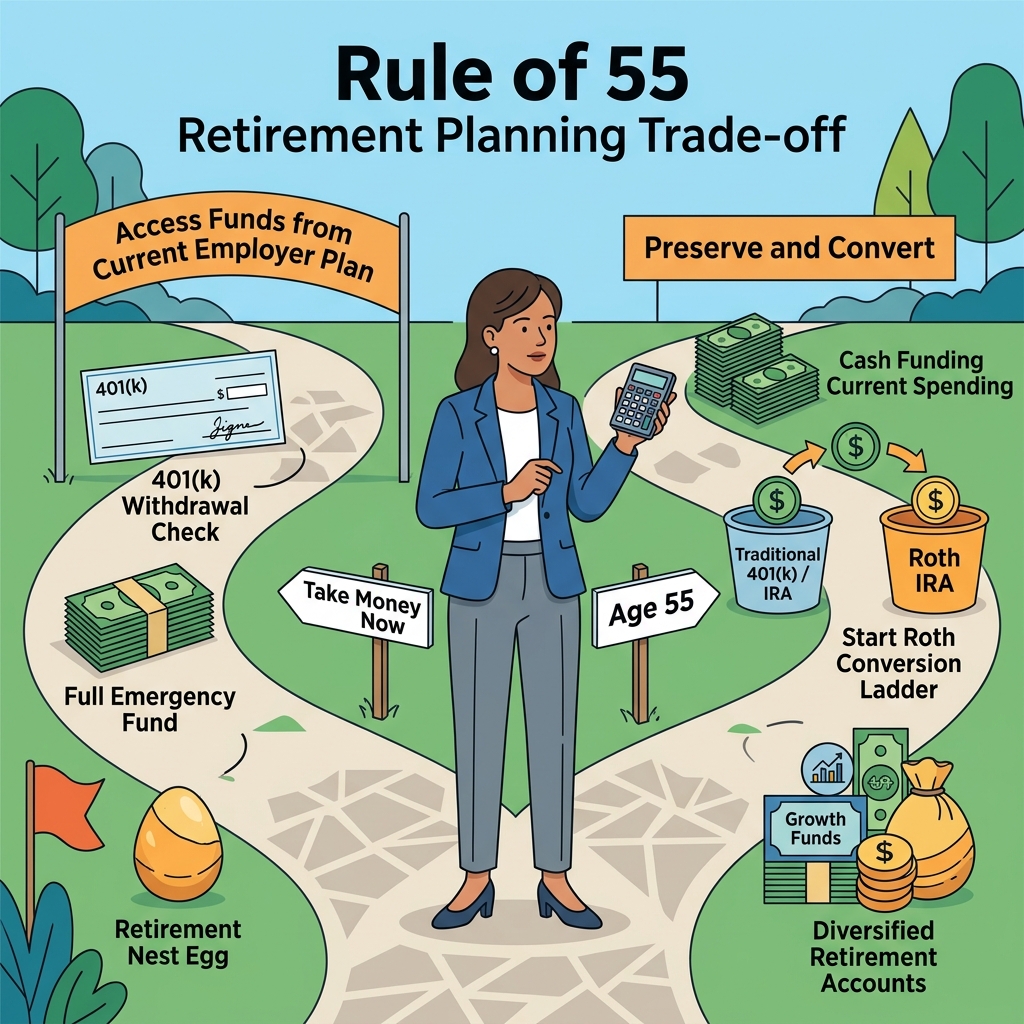
Taking money from the 401(k) could protect her cash reserve and make retirement easier today. Leaving the money invested could produce more growth and create room for Roth conversions that may lower taxes later.
The smartest answer may not be to use the Rule of 55 or avoid it completely. It may be to use just enough of it to support retirement while converting other pretax savings to Roth accounts as early as possible.
What is the Rule of 55?
Retirement-plan distributions taken before age 59½ are generally subject to regular income tax and an additional 10% federal tax unless an exception applies.
The Rule of 55 is one of those exceptions.
You may qualify when you separate from an employer during or after the calendar year in which you turn 55 and then withdraw money from that employer’s eligible retirement plan. Retirement, resignation and involuntary job loss may all qualify as a separation from service.
The calendar year matters more than your birthday.
Suppose you turn 55 in November 2027 but leave your job in February 2027, while you are still 54. Because you left during the calendar year in which you turn 55, later distributions from the qualifying employer plan may be exempt from the additional 10% tax.
Now suppose you leave in December 2026 and turn 55 the following November. Waiting until your birthday to withdraw generally does not make the distribution eligible. You left before the calendar year in which you reached 55.
Certain qualified public-safety employees may qualify under separate rules at age 50.
IRS Citations & Legal Sources
- 10% Additional Tax & Age 55 Exception: Internal Revenue Code (IRC) Section 72(t)(2)(A)(v) and IRS Publication 575 (Pension and Annuity Income).
- Public-Safety Employees (Age 50): IRC Section 72(t)(10).
- IRA Exclusion: The age 55 exception applies only to qualified employer plans. It explicitly does not apply to Individual Retirement Arrangements (IRAs) under IRC Section 72(t)(3)(A) and IRS Publication 590-B.
Rule of 55: Myth vs. Reality
| Common assumption | What is actually true |
|---|---|
| I can access every retirement account at 55 | The exception generally applies only to the qualifying employer plan |
| The withdrawal is tax-free | It avoids the 10% early-distribution tax, but regular income tax may still apply |
| I must retire on or after my 55th birthday | You may qualify if you leave anytime during the calendar year you turn 55 |
| I can roll the account into an IRA first | IRA withdrawals do not qualify for the Rule of 55 exception |
| My employer must offer flexible withdrawals | Distribution options depend on the plan |
| Using the rule is always better than waiting | Withdrawals may reduce growth and crowd out Roth conversions |
What the Rule of 55 saves—and what it doesn’t
The Rule of 55 may remove the additional 10% early-distribution tax. It does not turn a traditional 401(k) withdrawal into tax-free income.
If Rebecca takes $60,000 from her traditional 401(k), the taxable portion generally becomes ordinary income. The rule may help her avoid a $6,000 additional tax, but she could still owe federal and state income taxes on the distribution.
That distinction is easy to overlook:
Penalty-free does not mean tax-free.
The rule also generally applies only to the qualifying workplace plan—not to an IRA. Moving the entire 401(k) into an IRA before age 59½ can eliminate access to this particular exception.
Rule of 55 eligibility at a glance
| Situation | Does the Rule of 55 generally apply? |
|---|---|
| You leave your employer at 56 and withdraw from that employer’s plan | Potentially yes |
| You leave in January of the year you turn 55 in December | Potentially yes |
| You leave at 54 during the year before you turn 55 | Generally no |
| You remain employed and want to withdraw because you turned 55 | Not under this exception |
| You roll the 401(k) into an IRA and withdraw at 56 | No |
| You wait until age 59½ | The regular age exception applies |
Federal tax law is only part of the picture. The employer’s plan determines whether you can take partial distributions, monthly payments or only a limited number of withdrawals.
A Rule of 55 strategy is difficult to use when the plan requires a large lump-sum distribution or does not offer the payment schedule you need.
The Rule of 55 Planning Window
- Age 54: Leaving now may be too early
- Calendar year turning 55: Separation may qualify
- Age 56: Begin eligible plan withdrawals
- Age 59½: General early-withdrawal restriction ends
- Age 62–70: Social Security claiming window
- Age 65: Medicare eligibility
- Later retirement: Required minimum distributions begin under applicable law
Why using the Rule of 55 can be a smart move
The rule is especially valuable for people who are financially ready to retire but have most of their wealth tied up in workplace retirement accounts.
It can solve the early-retirement cash gap
Rebecca has more than $1.6 million across her accounts, but only $350,000 is held in cash and taxable investments.
Without access to the 401(k), she might need to spend most of those liquid assets before reaching age 59½. That could leave her with a large retirement balance but little readily available money for emergencies.
A measured Rule of 55 withdrawal gives her another source of income during the bridge years.
It can keep an emergency fund intact
Early retirees still have roofs to replace, cars to repair and family members who may need help.
Rebecca could avoid touching the 401(k) by spending almost all her cash first. But entering retirement with only a thin emergency reserve may be riskier than taking a modest taxable withdrawal.
The value of the Rule of 55 may be less about funding vacations and more about preventing the first unexpected expense from disrupting the plan.
It can reduce pressure to sell taxable investments
Suppose Rebecca retires during a stock market downturn. Selling a large portion of her brokerage portfolio could lock in losses.
She might instead draw from cash and take a limited 401(k) distribution while allowing the taxable investments more time to recover.
This does not eliminate market risk. Investments may also need to be sold inside the 401(k) to fund the withdrawal. But access to multiple account types gives Rebecca more control over what she sells.
It is usually less rigid than a 72(t) withdrawal plan
Substantially equal periodic payments, often called a 72(t) or SEPP strategy, can also provide access to retirement accounts before age 59½. But that approach requires a calculated series of payments and comes with restrictions on changing the schedule.
The Rule of 55 itself does not require equal annual withdrawals.
Rebecca might take $45,000 this year, $20,000 next year and nothing the following year—provided her former employer’s plan offers that flexibility.
Why leaving the 401(k) alone can also be smart
Just because Rebecca can use her retirement account does not mean it should be the first account she spends.
A 401(k) withdrawal can create more taxable income than a brokerage sale
Rebecca needs $92,000 for spending, but she does not necessarily need a $92,000 401(k) withdrawal.
Suppose she sells $60,000 of investments from her brokerage account. If those investments originally cost $45,000, her sale contains $45,000 of returned principal and $15,000 of capital gain.
A $60,000 traditional 401(k) distribution, by comparison, may add nearly the entire amount to ordinary taxable income.
The relevant question is not simply whether the 401(k) withdrawal avoids the additional 10% tax. It is whether the total tax cost is lower than the cost of using cash or taxable investments.
Early withdrawals lose future compounding
Suppose Rebecca withdraws $70,000 a year for three years, removing $210,000 from her 401(k).
The Rule of 55 could help her avoid as much as $21,000 in additional early-distribution taxes.
But that $210,000 is no longer growing in the account. At a hypothetical 6% annual return, $210,000 could grow to about $503,000 over 15 years.
That is not a prediction. Rebecca would take the withdrawals gradually, actual investment returns will vary, and she needs money to live on.
Still, it illustrates the hidden cost of early access. The Rule of 55 removes a tax penalty, not the opportunity cost of spending invested money sooner.
Withdrawals can affect health insurance costs
Someone retiring at 55 may need roughly a decade of coverage before Medicare.
Marketplace Premium Tax Credit calculations are based on household income using modified adjusted gross income. Taxable retirement-account withdrawals can increase that income and potentially reduce the credit.
Rebecca might save $5,000 by avoiding the additional 10% tax on a $50,000 withdrawal, yet lose part of her health insurance assistance and owe more regular income tax.
That does not make the withdrawal a bad idea. It means the full cost should be calculated before the money comes out.
The overlooked opportunity: Use the Rule of 55 alongside Roth conversions
Many people think of the Rule of 55 as a way to withdraw money for spending. Its more interesting use may be helping an early retiree begin a Roth conversion strategy sooner.
A Roth conversion moves pretax retirement money into a Roth account. Previously untaxed amounts are generally included in income in the year of the conversion. Future qualified Roth withdrawals may be tax-free. Employer plans may also permit in-plan Roth rollovers, although plans are not required to offer them.
The years immediately after retirement can be particularly valuable for conversions.
Rebecca’s salary has disappeared. She has not started Social Security. Required minimum distributions are still years away. Her taxable income could be lower now than it was during her career or will be later in retirement.
Instead of waiting until age 59½ or later, she may be able to start moving money into Roth accounts at 56.
The Rule of 55 can help fund the years when conversions happen
A Roth conversion creates taxable income but does not provide spending money. The converted assets move from one retirement account to another.
Rebecca still needs money for groceries, housing, travel and taxes.
The Rule of 55 can provide part of that spending money while she converts a separate portion of her pretax savings to Roth.
For example:
| Annual transaction | Illustrative amount |
|---|---|
| Cash and interest used for spending | $20,000 |
| Brokerage-account sales | $37,000 |
| Rule of 55 withdrawal for spending | $35,000 |
| Total available for spending | $92,000 |
| Separate Roth conversion | $45,000 |
In this simplified example, Rebecca takes $35,000 from the 401(k) to help fund her lifestyle and converts another $45,000 to a Roth account.
Both transactions can increase taxable income. The key is that she is not withdrawing the entire $80,000 for spending. Part of it remains invested and begins growing in the Roth account.
She can choose conversion amounts based on a target tax bracket, available cash for the tax bill and the effect on Marketplace health insurance.
Early conversions give Roth money more time to grow
Starting at 56 instead of waiting until the 60s gives converted assets additional years to potentially compound.
A $45,000 conversion growing at a hypothetical 6% annual rate would be worth about $108,000 after 15 years. The future value would be held in a Roth account, where qualified distributions may be tax-free.
The benefit becomes larger when Rebecca repeats the process over several years.
She might convert:
| Retirement year | Illustrative Roth conversion |
|---|---|
| Age 56 | $45,000 |
| Age 57 | $50,000 |
| Age 58 | $55,000 |
| Age 59 | $50,000 |
| Total converted | $200,000 |
Instead of entering her 60s with nearly all her retirement savings in pretax accounts, Rebecca would have started building a tax-free pool much earlier.
Early conversions can shrink future taxable withdrawals
Money converted to Roth no longer remains in the pretax account that may later produce taxable withdrawals.
Reducing that balance can help Rebecca diversify her retirement income:
- Traditional 401(k) or IRA withdrawals that are generally taxable.
- Roth withdrawals that may be tax-free when distribution requirements are met.
- Brokerage withdrawals with taxable gains determined by cost basis.
- Cash that generally does not create income when spent.
This flexibility can be valuable later when Rebecca wants to pay for a large trip, help a child with a home purchase or cover an expensive home renovation without creating a large increase in taxable income.
Starting sooner can begin important Roth holding periods
Roth accounts have holding-period rules that can affect whether distributions are qualified. Roth IRA conversions can also carry separate five-year considerations for people who withdraw converted amounts before age 59½.
Beginning the Roth strategy earlier may start these time periods sooner.
But Rebecca should not assume that recently converted money is immediately available for penalty-free spending. The Rule of 55 exception applies to eligible distributions from the employer plan; it does not simply follow converted money into a Roth IRA.
That is one reason she may want to use Rule of 55 withdrawals for current spending while leaving converted assets invested.
A two-bucket strategy can preserve both options
Rebecca does not necessarily have to choose between keeping everything in the 401(k) and rolling everything into an IRA.
If her plan permits partial distributions and partial rollovers, she could divide the money by purpose.
Bucket 1: Money reserved for Rule of 55 withdrawals
Rebecca could leave enough in her former employer’s 401(k) to cover the spending gap until age 59½.
For example, she might leave $200,000 to $250,000 in the plan, depending on her expected needs, investment mix and emergency reserve.
That money remains available under the Rule of 55, subject to the plan’s distribution terms.
Bucket 2: Money positioned for gradual Roth conversions
She might directly roll another portion to a traditional IRA and convert manageable amounts to a Roth IRA each year.
A direct rollover to a traditional IRA is generally not taxable, while the later Roth conversion generally creates taxable income to the extent the converted money has not already been taxed.
The important catch is that the Rule of 55 does not apply to money once it has been moved to an IRA. Rebecca should avoid transferring the money she expects to use for penalty-free spending.
The sequence matters:
- Estimate how much needs to remain accessible before age 59½.
- Confirm the former employer plan allows the desired withdrawals.
- Leave the bridge money inside the qualifying plan.
- Consider rolling the remaining portion to an IRA.
- Convert selected amounts to Roth over several tax years.
- Pay conversion taxes from cash or taxable assets when practical.
This approach can preserve near-term access while beginning long-term tax diversification.
But Rule of 55 withdrawals and conversions compete for the same tax space
The strategy has an important limitation: Both taxable 401(k) withdrawals and pretax Roth conversions can increase taxable income.
Suppose Rebecca wants to keep her income within a target federal tax bracket. If she has room for $80,000 of additional ordinary income, she could use that space in several ways:
One Tax Bracket, Two Competing Uses
More withdrawal = more money to spend now.More conversion = more money repositioned for potentially tax-free use later.
View Data TableHide Data Table
| Strategy | Rule of 55 Withdrawal | Roth Conversion |
|---|---|---|
| Spending-focused | $80,000 | $0 |
| Balanced | $35,000 | $45,000 |
| Conversion-focused | $10,000 | $70,000 |
The spending-focused strategy provides the most cash today but does little to reduce future pretax balances.
The conversion-focused strategy moves more money into Roth but requires Rebecca to rely heavily on cash and taxable investments for current expenses.
The balanced strategy tries to accomplish both.
There is no universally correct split. The right mix depends on Rebecca’s tax bracket, cost basis in the brokerage account, health insurance, investment allocation and expected future income.
When pairing the Rule of 55 with Roth conversions may work well
The combined strategy may be especially attractive when:
- Most retirement savings are held in pretax accounts.
- The retiree has entered a meaningfully lower tax bracket after leaving work.
- Cash or brokerage assets are available to pay conversion taxes.
- The employer plan allows flexible partial distributions.
- The retiree expects higher taxable income after Social Security and future required distributions begin.
- The retiree wants more tax-free money available later in retirement.
- Marketplace health insurance costs can be managed within the planned income level.
The goal is not to convert as much as possible regardless of cost. It is to move money at tax rates the retiree considers favorable without creating larger problems elsewhere.
When using the Rule of 55 may be the wrong move
Rebecca may be better off minimizing withdrawals when she has ample taxable savings, wants to complete larger Roth conversions or would lose valuable health insurance assistance by increasing income.
The rule may also be unattractive if her former employer’s plan has high fees, poor investment choices or restrictive withdrawal policies.
And penalty-free access cannot fix an unaffordable retirement.
Withdrawing $30,000 annually from a $1.25 million account is a different decision from taking $120,000 annually from a $500,000 account. The Rule of 55 changes the tax treatment of an early distribution. It does not make an unsustainable withdrawal rate safe.
Five Rule of 55 mistakes to avoid
1. Leaving work one calendar year too early
Leaving at 54 during the year before you turn 55 generally does not qualify, even when you wait until your birthday to withdraw.
2. Rolling the entire balance into an IRA immediately
The Rule of 55 does not apply to IRA distributions. Keep expected bridge expenses in the qualifying employer plan when preserving early access is important.
3. Converting too much in one year
A large Roth conversion can push income into a higher tax bracket and affect income-based tax benefits. Conversion amounts should be planned year by year.
4. Spending recently converted Roth money too soon
Roth conversion and distribution rules are separate from the Rule of 55. Recently converted amounts can be subject to five-year considerations when withdrawn before age 59½.
5. Looking only at the avoided 10% tax
Regular income taxes, health insurance credits, future investment growth and Roth conversion opportunities may have a larger financial impact than the penalty itself.
Questions to ask before leaving your employer
Before Rebecca retires or moves any money, she should ask the plan administrator:
- Does the plan allow partial distributions after separation?
- How frequently can withdrawals be requested?
- Is there a minimum distribution amount?
- Can part of the account remain in the plan?
- Are partial direct rollovers permitted?
- Does the plan offer an in-plan Roth rollover?
- What fees apply after employment ends?
- How will distributions be reported for tax purposes?
Plans may permit in-plan Roth rollovers, but they are not required to offer them and may limit the eligible amounts or frequency.
These questions should be answered before the final paycheck—not after the entire account has already been transferred.
The best answer may be to use the rule without leaning on it
Rebecca decides not to fund her entire early retirement from her 401(k).
She leaves enough money in the former employer plan to cover potential withdrawals until age 59½. She uses cash and selective brokerage sales for part of her annual spending, takes modest Rule of 55 withdrawals when necessary and begins a series of Roth conversions.
In one year, she might withdraw $35,000 and convert $45,000. In another year, a consulting project might provide enough income that she skips the withdrawal and reduces the conversion. During a market downturn, she may convert investments at temporarily lower values.
The plan can change each year because her tax return, investment portfolio and health insurance costs will change too.
That flexibility is the real value of the Rule of 55.
It does more than open the 401(k) door early. Used carefully, it can provide enough income to make retirement work today while giving the rest of the portfolio a better tax structure for tomorrow.
Educational Disclaimer
This article is for informational and educational purposes only and is not individualized financial, tax or legal advice. Retirement-plan rules and tax laws can change. Consider consulting a qualified financial or tax professional before making a decision.
Related Case Studies

Pay Off the Mortgage or Not Before Retirement?
An analysis of whether retirees should use their savings to eliminate their mortgage or keep the money invested.

Roth 401(k) vs Traditional 401(k) for High Earners
An analysis of whether high-income professionals should use a Roth or Traditional 401(k) for maximum after-tax wealth.