Amit and Padma have followed the retirement-saving playbook for nearly 30 years. They earned graduate engineering degrees, built successful careers at major technology companies and consistently contributed the maximum to their workplace retirement plans.
Along the way, they accumulated employer stock, taxable investments and a valuable Bay Area home. Now Amit, 56, and Padma, 54, want to enjoy the life they spent decades building.
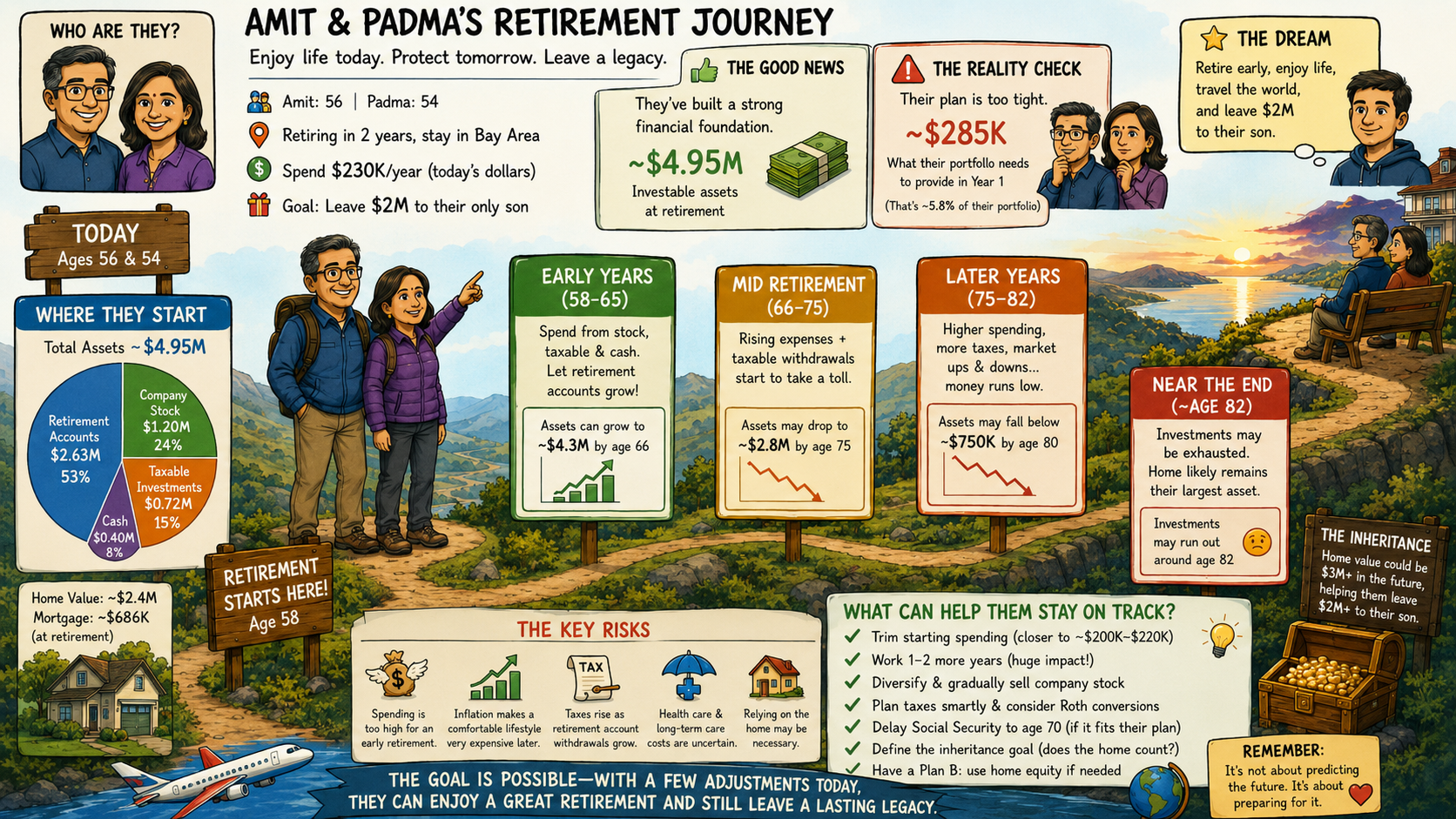
Their plan is to retire together in two years, remain in the Bay Area, travel regularly and spend about $230,000 a year. They also want to leave at least $2 million to their only son.
It is an appealing goal, and not an impossible one. But the numbers suggest they cannot retire, preserve every part of their current lifestyle and protect the full inheritance without making a few important changes.

The verdict: Early retirement is possible, but the plan is too tight
Amit and Padma may have approximately $4.95 million in financial assets when Amit turns 58. That includes retirement accounts, employer stock, taxable investments and cash.
That is a substantial portfolio. The challenge is that their retirement will also be expensive.
Their stated lifestyle budget is $230,000 a year, but that does not include everything their investments may need to cover. Once health insurance, taxes, rising prices and other costs are included, their first-year withdrawal could be closer to $285,000.
That is nearly 5.8% of their starting portfolio. For a couple retiring in their 50s, that leaves little room for disappointing investment returns, unexpected health expenses or a longer-than-expected retirement.
If their spending continues as planned, their investment accounts could be exhausted around Amit’s early 80s. They would still own a valuable home, but they might eventually need to sell it, borrow against it or make a major lifestyle change.
Amit and Padma are close to making early retirement work. They simply are not there under the current plan.
Their $230,000 lifestyle may really cost $285,000
Retirement budgets often look manageable until health insurance and taxes enter the picture.
Amit and Padma expect to spend about $180,000 on essential expenses and another $50,000 on travel, entertainment and other extras. By the time they retire, rising prices may push that total closer to $242,000.
They may also need about $32,000 a year for private health insurance before they become eligible for Medicare. Taxes and other health-related expenses add more, bringing their first-year portfolio withdrawal to roughly $285,000.
That gap between $230,000 and $285,000 is not a minor detail. It is the difference between a retirement plan that appears comfortable and one that begins with a fairly heavy withdrawal.
Amit and Padma need to build their budget around everything the portfolio must pay, not just the amount they expect to spend on housing, dining and travel.
The early years could feel surprisingly comfortable
One reason the plan may seem safer than it is: The financial pressure does not arrive immediately.
Amit and Padma intend to spend employer stock, taxable investments and cash before taking large withdrawals from their traditional retirement accounts. That allows their 401(k)s and IRAs to continue growing during the first several years.
Their employer stock could last until Amit is about 63. Their remaining taxable investments and cash may carry them into their mid-60s. Meanwhile, their retirement accounts could grow to roughly $4.3 million around Amit’s age 66.
They could still have more than $4.2 million invested at age 70. That is the kind of account balance that can make retirement feel secure.
The picture changes later, however, as living costs continue rising and more withdrawals begin coming from taxable retirement accounts. The first decade may feel easy. The later decades are where the strain becomes harder to ignore.
A comfortable lifestyle becomes much more expensive over time
Amit and Padma do not plan to sharply reduce their standard of living as they age. Their spending rises with inflation, which means an already expensive lifestyle becomes considerably more expensive later.
Their annual costs could reach about $325,000 when Amit is 70, $368,000 at 75 and $416,000 at 80. If they live into their mid-90s and maintain the same purchasing power, annual spending could eventually exceed $600,000.
Social Security will help, but it will cover only a fraction of those expenses. Taxes may also become a bigger burden once Amit and Padma begin taking large withdrawals from traditional 401(k)s and IRAs.
Those withdrawals are generally taxed as ordinary income. The more money they need for living expenses, the more they may also need to withdraw to cover the resulting tax bill.
Their investment balance could fall to roughly $2.8 million at age 75, about $1.2 million at 79 and less than $750,000 at 80. By Amit’s early 80s, the investment accounts could be nearly empty.
The issue is not that they are spending irresponsibly. They are planning a high-cost retirement in a high-cost area, and they want that lifestyle to last for several decades.
That is an expensive promise for any portfolio to keep.

Their house may protect the inheritance but complicate retirement
Amit and Padma own a Bay Area home worth about $2.4 million. If the property continues gaining value and the mortgage is eventually paid off, the house could become the largest part of their estate.
It may ultimately be worth far more than the $2 million they hope to leave their son. That is encouraging, but there is an important catch.
Home equity is valuable, but it does not automatically pay for groceries, health care, property taxes or airfare. To turn the house into spendable money, Amit and Padma would need to sell it, borrow against it, rent part of it or move somewhere less expensive.
They could eventually find themselves owning a home worth several million dollars while holding very little in their investment accounts. They would be wealthy on paper but short on cash.
That means the house needs a clearly defined job. Is it primarily their long-term home, a backup source of retirement money or the inheritance they hope to preserve?
It may serve more than one purpose, but it cannot do everything without trade-offs.
The inheritance goal needs a clearer definition
“We want to leave our son $2 million” sounds precise, but it still leaves several unanswered questions.
Does the house count toward the goal? Do Amit and Padma want their son to receive $2 million in investments in addition to the property? Are they referring to $2 million in future dollars or the equivalent purchasing power of $2 million today?
Those versions of the goal are very different.
If the Bay Area house counts as part of the inheritance, they may already be close. The home is currently worth about $2.4 million before subtracting the mortgage.
If they want to leave $2 million in liquid investments while also preserving the house, the goal becomes much harder.
A useful approach would be to identify one portion of the estate for their son. That might be a specific investment account, part of the home’s eventual value or a set percentage of the total estate.
Everything else would remain available for Amit and Padma’s own retirement. That creates a clear boundary between the money they plan to enjoy and the money they hope to preserve.
They may need to spend less without living less
Amit and Padma’s biggest obstacle is not a lack of savings. It is the cost of the retirement they want.
That does not mean they need to give up travel, move immediately or spend retirement worrying about every purchase. It does mean they should decide which expenses are essential and which can move up or down.
Housing, food, insurance, health care and basic transportation belong in the core budget. Premium travel, large gifts, luxury purchases and expensive hobbies can sit in a more flexible category.
During strong financial years, Amit and Padma could spend more freely. During weaker years, they could choose a less expensive trip, postpone a large gift or trim other optional costs.
That kind of flexibility can make a meaningful difference. A portfolio has a much easier time supporting a household that can adjust than one that raises every spending category automatically each year.
The goal is not to make retirement smaller. It is to keep it adaptable.
One or two more working years could change the picture
Amit and Padma still have two high incomes, which gives them an advantage many retirement savers do not have.
Working even one or two additional years could allow them to save more, give their investments more time to grow and reduce the number of years the portfolio must support. They could also remain on employer health insurance longer and continue paying down the mortgage.
That does not necessarily mean staying in demanding executive jobs indefinitely. One spouse could retire first, while the other continues working. Amit or Padma could move into consulting, advisory work or a less intense position.
Even modest income during the first several retirement years could reduce the amount they need to withdraw from investments.
After three decades of work, delaying retirement may not sound appealing. But one extra year at a high salary can sometimes buy several years of additional financial comfort later.
Company stock has done its job
Amit and Padma have approximately $1.2 million in employer stock, representing close to 29% of their financial assets.
Those shares helped them build wealth. They also create considerable risk at the exact moment the couple is preparing to stop earning salaries.
Their careers, bonuses, benefits and investments have all depended heavily on the technology sector. If the sector struggles, they could see their portfolio decline at the same time that returning to a similarly paid job becomes more difficult.
They do not need to sell every share at once. A gradual sale over several years may help manage taxes and reduce the risk of making one large move at the wrong time.
The important step is to stop treating employer stock as a permanent family holding. The shares were part of their compensation. They do not need to remain the centerpiece of their retirement.
Taxes could become an expensive companion
Amit and Padma hold much of their savings in traditional retirement accounts. Those accounts gave them valuable tax benefits while they were working, but withdrawals will generally be taxable.
As they begin using more of that money, their tax bills could rise sharply. The years immediately after retirement may offer opportunities to move some money from traditional retirement accounts into Roth accounts.
Paying some tax earlier could reduce taxable withdrawals later. But this is not a simple cure.
Any conversion should be coordinated with federal and state tax brackets, health insurance costs, Medicare premiums, charitable giving and Social Security.
Good tax planning may help Amit and Padma keep more of what they have. It cannot make an overly expensive lifestyle affordable on its own.
Social Security should match the rest of the plan
Amit and Padma have talked about waiting until age 70 to claim Social Security. Some of their retirement figures assume they begin at 62.
They need to choose one approach and use it consistently.
Claiming early would provide income sooner and reduce the amount they need to withdraw during the first several years. Waiting until 70 would provide larger monthly checks for the rest of their lives.
For a couple expecting a long retirement, those larger later benefits may be valuable. But waiting also puts more pressure on their investments during their 60s.
The best choice depends on their health, family longevity, taxes and final retirement date. It should be made alongside the rest of the retirement strategy, not treated as an isolated decision.
They should decide what might make them leave the house
Amit and Padma may love their home and have no interest in moving. That is perfectly reasonable.
Still, they should discuss what circumstances could change their minds. They might decide to downsize if their investments fall below a certain level, if property taxes and maintenance become burdensome or if one spouse needs long-term care.
They could also consider renting part of the home, adding a separate living space or using home equity later in retirement.
Making those decisions in advance is easier than facing them during a health or financial crisis. Their home may ultimately be the asset that protects both their retirement and their son’s inheritance, but only if they are willing to use it thoughtfully.
Long-term care deserves a place in the conversation
Amit and Padma have included health insurance and regular medical costs in their retirement budget. What is less clear is how they would pay for extended home care, assisted living or nursing care.
Those expenses could quickly change the inheritance picture.
They might choose to use investments, insurance, home equity or a combination of the three. There is no single answer that works for every family, but ignoring the possibility is risky.
Their son’s inheritance can remain an important goal. Amit and Padma’s own financial security should come first.
Is their plan guaranteed?
No retirement plan comes with a guarantee.
Investment returns can disappoint. Inflation can remain high. Tax rules may change. One spouse may live much longer than expected, and health care may cost more than planned.
The purpose of retirement planning is not to predict every future expense perfectly. It is to leave enough room to handle surprises without turning retirement into a financial emergency.
Amit and Padma currently have substantial wealth but limited room for error. They want to retire early, spend generously, remain in an expensive home and preserve a large inheritance.
That is a lot to ask from one portfolio.
Their chances improve if they combine several manageable changes: work a little longer, lower the starting budget, diversify employer stock, settle on a Social Security strategy and decide how much of the home may eventually be used for retirement.
Amit and Padma have already completed the difficult part. They built the wealth.
Now they need to decide how much of it is meant to fund the life they want—and how much they can reasonably promise to leave behind.
Educational Disclaimer
The financial projections, strategies, and verdicts presented in this case study are for educational purposes only. They rely on assumptions about market returns, inflation, and tax rates that are inherently unpredictable. This content does not constitute personalized financial, legal, or tax advice. Always consult with a qualified financial professional before making retirement decisions.
Related Case Studies

Can Four Rentals Fund an Early Retirement at 52?
Daniel and Maya have built serious real estate wealth. Turning it into a reliable paycheck is the harder part.

Laid Off at 58 and Replaced by AI: Can Marcus Retire?
Marcus has $1.82 million invested, a pension and valuable home equity. But an unexpected early retirement could leave him short later.

Divorce at 49: Which Settlement Buys Rachel Freedom?
Rachel can keep the house, take more investments or cut financial ties with her ex. Only one option keeps early retirement within reach.